
The Intelligence Gap Nobody in Security Wants to Discuss
The failure was never the team.
It was the intelligence.
Security failures rarely begin in the moment. They begin weeks earlier — in unnoticed decisions, overlooked indicators, and unexamined vulnerabilities that quietly create the conditions for risk.
The most common cause of a security breakdown is not a lack of personnel, inadequate training, or slow response.
It is the absence of intelligence.
A team arrives at a location that was never properly assessed. A route is selected for convenience rather than security. A principal’s digital footprint remains exposed for months without review. By the time the threat becomes visible, the conditions that enabled it have already been established.
This is the intelligence gap.
It exists throughout the industry far more often than most are willing to acknowledge.
Traditional close protection is, by nature, reactive. It places trained professionals around a principal and responds to threats as they emerge. The flaw in that model is straightforward: by the time a threat is visible, the opportunity to prevent it may already have passed.
Intelligence-led protection operates differently.
Every decision in close protection — where the principal goes, when, how, and with what resources — is informed by a continuous assessment of the threat environment, not fixed routines or assumption. It shifts the team from reactive (responding to an attack) to proactive (pre-empting or avoiding one entirely).
It begins long before movement starts.
Environments are assessed before a principal enters them. Digital exposure is identified before adversaries can exploit it. Threat actors are mapped before they can establish intent or capability. Risks are understood before decisions are made.
The objective is not just to respond effectively when something happens.
The objective is to ensure it is mitigated before it can.
Principals who have experienced both approaches rarely return to conventional protection alone. They understand they are not simply investing in a security team. They are investing in as much certainty as possible that foreseeable risks have been identified, analysed, and mitigated before a single move is made — with a continuous intelligence feedback loop running through every layer of the detail.
That certainty cannot be improvised on the day.
It is built quietly, methodically, and long in advance.
The most effective protection is often invisible. It exists in the assessments never seen, the vulnerabilities identified before they are exploited, and the decisions informed by a deeper understanding of people, behaviour, and intent.
At the foundation of this approach sits the threat assessment — the attempt to quantify risk and form the basis of the security plan. It is the primary tool an executive protection team uses to control exposure.
A rigorous threat assessment draws on multiple inputs:
· Empirical data
· Isomorphic learning
· Historical data
· Quantified risk analysis derived from threat
The threat assessment is a foundational component of risk management — but it is one tool. Intelligence-led protection takes that foundation and layers the full intelligence picture into the process of building the security plan, adding depth, scrutiny, and foresight that a standalone assessment cannot provide.
Here is a simple overview of how it works in practice:
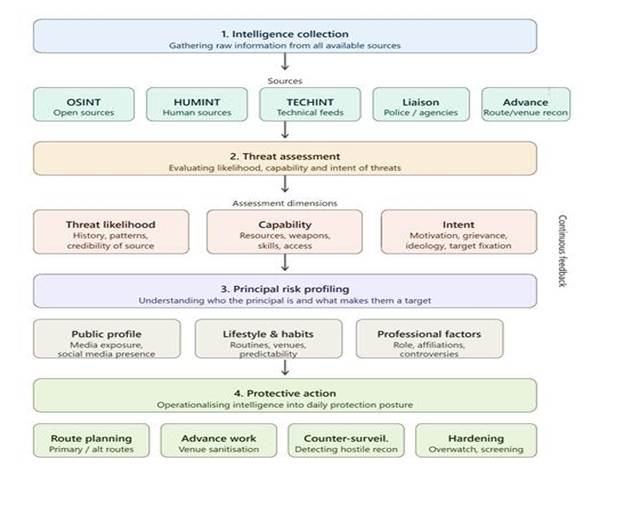
If your security provision begins when the movement starts, it has already started too late.
This is the problem Greyveil was built to solve.
Intelligence before protection. Mitigation before movement.
Strategic intelligence. Protection that begins before the threat is visible.
Quietly in control.
GREYVEIL LTD · PRIVATE SECURITY SERVICES · SPECIAL PROJECTS
enquiries@grey-veil.com · grey-veil.com